Mini-Kit ‘Sound’
Investigating Vibrations, Sounds and Sound Transmission
Age: 8–14 years
Materials: for 1 working group or demonstration
Use: Student experiments and demonstrations on vibrations, sound generation, sound transmission, sound amplification, and high and low tones
With the Mini-Kit ‘Sound’, students investigate fundamental phenomena related to sound, tones and vibrations. Eight practical experiments provide a step-by-step introduction, from exploring how sound is produced to generating different tones and combinations of tones.
Students first investigate how vibrating objects produce sound. Using a tuning fork, vibrations can be made visible through movement on the surface of water. Further experiments demonstrate that sound exerts pressure and can be amplified by suitable resonating bodies.
Using the listening tube and earpieces, students investigate how sound is transmitted and compare differences in perceived volume. Experiments with high and low tones also demonstrate the relationship between the rate of vibration and pitch.
Test tubes and sound plates extend the investigations to vibrating air and musical combinations of tones. In this way, students explore fundamental principles of acoustics through observation, listening and hands-on experimentation. Instructions support the completion of the experiments.
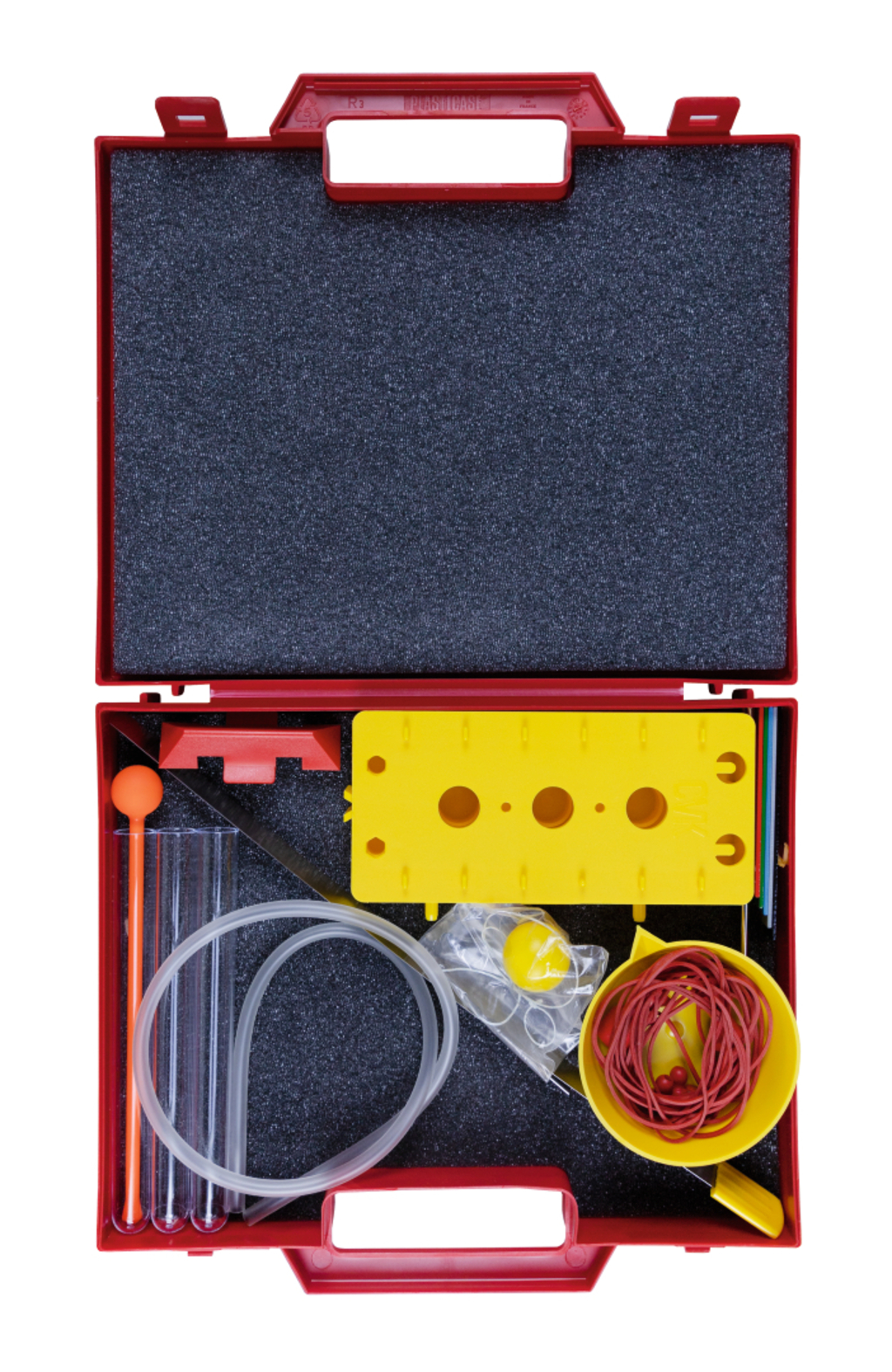

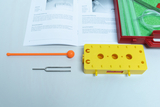
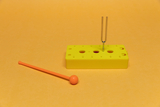


Technical specifications
Size of kit: 270 x 210 x 50 mm
The students examine the sound - the basic question "What is sound?" is answered by a spring steel strip and a steel needle.
In this experiment, a tuning fork is struck and held in a bowl of water. The behavior of the water surface is observed.
In this experiment, a ball is held by the thread to a tuning fork. This is struck and the students observe the behavior of the ball.
In this experiment it is observed when a sound can be amplified.
The volume of the sound is compared through a hearing tube and an ear piece.
The students use high and low tones to investigate when a tone-producing body vibrates faster or slower.
The students use test tubes to check whether sounds can be heard.
In this experiment, sound bars are stimulated to vibrate, which produce a tone and are transmitted through the air as sound.
- 1 ×
- 3 ×
- 1 × Triangular bridges
- 1 × Sets of sound plates
- 1 × Water basin, plastic, 80 mm dia.
- 1 ×
- 1 ×
- 1 × Hearing tube
- 2 × Lidfoam R3, grey 260x200x10 mm
- 1 × Tuning fork, 95 mm long not tuned
- 2 × Cord stretcher
- 1 × Spring steel strip with oscillation head, 300 mm
- 1 × Sound box, 3 parts
- 1 ×
- 4 ×